Fixing a Sudden Drop in Hot Water Pressure After a City Water Main Repair
The Sudden Impact of City Water Repairs on Your Home's Plumbing
You turn the shower dial expecting a warm blast, but instead, you get a sputtering, weak trickle. Fixing a sudden drop in hot water pressure after a city water main repair starts with understanding exactly what just invaded your plumbing. At Brooks Heating & Air, our team fields countless calls about this exact scenario. When the city restores water after a neighborhood shutoff, the initial surge often pushes a massive flush of dislodged sediment, rust, and dirt directly into residential lines. A sudden drop in hot water pressure right after utility trucks leave your street is a highly common, frustrating experience for homeowners. The immediate challenge is determining if this low pressure is a simple fixture clog or a complex internal blockage in your heating unit.
For expert help, explore our Georgetown HVAC and water heating services or schedule a water heater inspection today.
How Sediment Travels Through Your Pipes
Understanding how this debris travels through your home is the first step to restoring full hot water flow safely. When the main line is repressurized, the water acts like a broom, sweeping up all the loose particles that settled during the repair. This debris cloud travels rapidly through your home's main water line until it hits the narrowest restriction points.
Because the Georgetown ON municipal water system covers a wide and varied geographic area, the type of sediment pushed into your home can range from fine silt to larger flakes of pipe scale. Homeowners must quickly determine the scope of the problem to avoid damaging sensitive plumbing fixtures.
• Low hot water pressure at only one sink — Likely Location of Blockage: Isolated fixture aerator or cartridge — Initial Action Required: Clean the specific faucet aerator
• Low hot and cold pressure at one sink — Likely Location of Blockage: Isolated fixture aerator or supply line — Initial Action Required: Clean the aerator and check the local valve
• Low hot water pressure throughout the entire house — Likely Location of Blockage: Water heater inlet screen or internal valves — Initial Action Required: Professional water heater diagnostic
How Freeze-Thaw Cycles and Main Breaks Introduce Sediment
Underground municipal water pipes are constantly subjected to thermal contraction and ground shifting. This is not a rare occurrence; it is a predictable reality of local geography and climate. In our years working on plumbing and HVAC systems throughout Georgetown, we've seen firsthand how local winter freezes and seasonal spring ground thawing specifically stress municipal plumbing infrastructure, making these sediment flushes an inevitable reality.
The Mechanics of a Main Break
When the ground freezes, it expands, putting immense physical pressure on buried water mains. Conversely, when the spring thaw arrives, the ground settles and shifts. These intense seasonal transitions cause older municipal pipes to crack or separate. When a main breaks and is subsequently repaired by city crews, earth, rust, and mineral scale inevitably enter the municipal water supply.
Once the repair is complete and the heavy valves are turned back on, a pressure wave forces this foreign material downstream. Standard residential water meters and basic whole-house filters are often not fine enough to catch this sudden, high-volume influx of micro-sediment.
• Thermal contraction: Cold temperatures cause pipe materials to shrink, weakening joints.
• Ground heaving: Frozen soil expands, pushing against rigid municipal lines.
• Pressure surges: The act of turning city water back on creates a shockwave that knocks loose internal pipe scale.
Because the Georgetown ON municipal water system deals with these severe temperature swings annually, local homeowners frequently find themselves on the receiving end of these sediment flushes. The debris bypasses basic screens and makes a direct line for your home's internal plumbing network.
Why Cold Water Pressure Returns While Hot Water Remains a Trickle
One of the most confusing aspects of a post-repair sediment flush is how it affects different taps. You might go to the kitchen sink, turn on the cold water, and find the pressure is completely normal. However, the moment you switch it to hot, the flow drops to a useless trickle. This happens because of the distinct mechanical differences between your hot and cold water supply lines.
The Unrestricted Path of Cold Water
Cold water lines generally have wider internal diameters and fewer mechanical restriction points. When the sediment cloud enters your house, the cold water simply carries it along. While some debris might get caught in a faucet aerator, the majority of the cold water path is essentially an open highway, allowing moderate sediment to pass through to the tap with minimal pressure loss.
The Bottleneck Effect in Heating Systems
Hot water, on the other hand, must first pass through the complex internal mechanics of a water heating system before reaching your fixtures. Modern heating systems are designed with extremely narrow tolerances to maximize energy efficiency and precise temperature control. When the sediment surge hits these narrow pathways, it acts like a dam, instantly choking off the hot water supply to the rest of the house.
The vulnerable components include:
• Inlet screens: The first line of defense, which clogs rapidly under a heavy sediment load.
• Tankless water heater flow sensors: Highly sensitive magnetic turbines that calculate exactly how much water is moving through the unit.
• Mixing valves: Precision components that blend hot and cold water to prevent scalding.
Because tankless water heater flow sensors require a specific volume of water to even trigger the burners, a partial blockage doesn't just reduce pressure—it can completely prevent the unit from heating the water at all.
Safe Troubleshooting: Clearing Sediment from Fixture Aerators
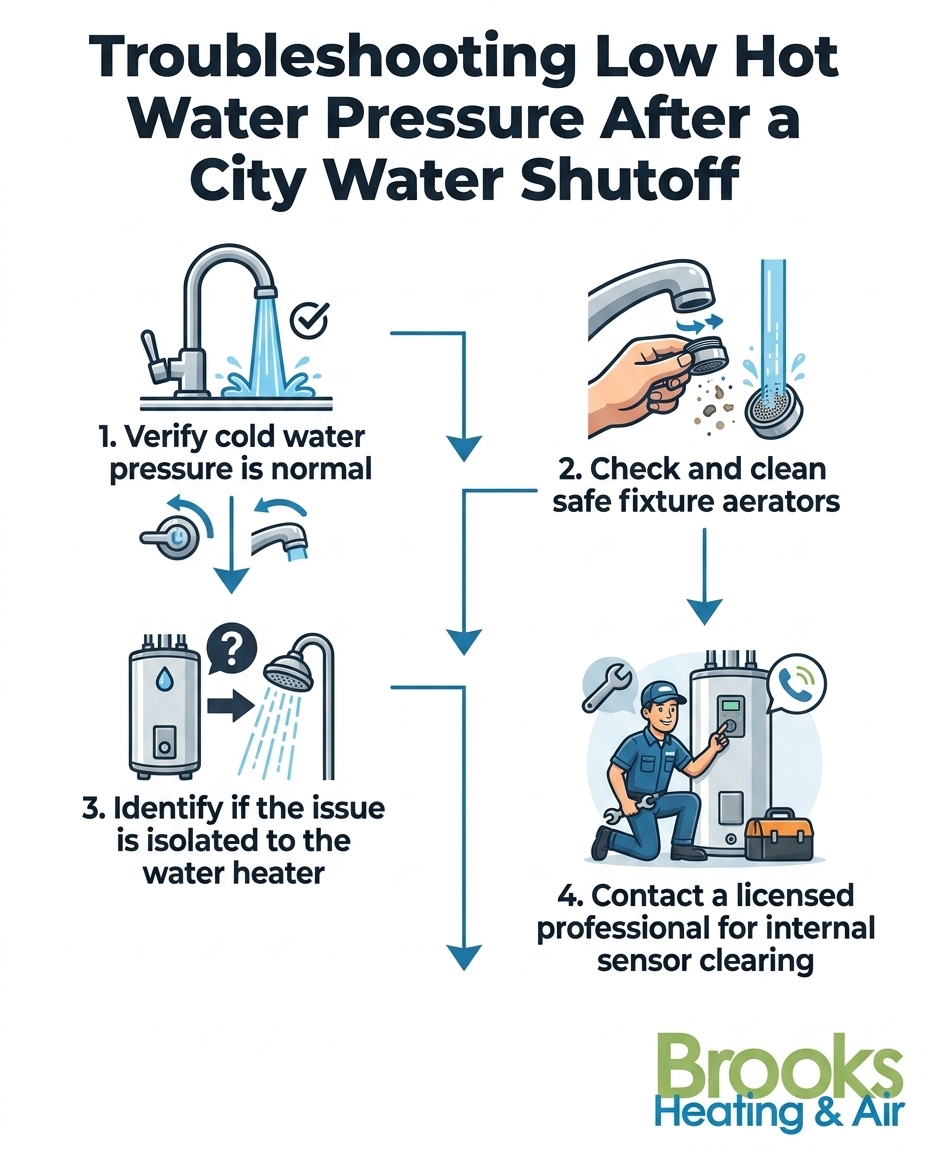
Before investigating the water heater or assuming your system is permanently damaged, homeowners should isolate the issue by checking individual plumbing fixtures. Faucet aerators and showerhead screens are designed to catch debris and are the easiest restriction points to clean safely. This is a straightforward process that requires no special licensing or complex tools.
Step-by-Step Fixture Isolation
Follow these steps to safely clear minor sediment blockages at the point of use:
1. Test every tap in the house: Go to every sink, shower, and tub. Turn on only the hot water, then only the cold water. Take note of which fixtures have low pressure. If only one or two sinks are affected, the problem is localized to those aerators.
2. Protect the finish: Wrap a small rag or microfiber cloth around the tip of the faucet to prevent scratching the metal finish.
3. Unscrew the aerator: Using your hand (or a pair of pliers over the rag if it is too tight), gently unscrew the aerator at the tip of the faucet counter-clockwise.
4. Disassemble and inspect: Carefully separate the outer metal ring, the internal plastic mesh, and the rubber O-ring. You will likely see small rocks, grit, or rust trapped in the mesh.
5. Rinse backward: Hold the mesh screen upside down under a different faucet running cold water to push the sediment out the way it came in.
6. Reassemble and test: Put the aerator back together, screw it onto the faucet hand-tight, and test the hot water pressure again.
If cleaning the aerators does not restore hot water pressure, the blockage is not at the fixtures. The sediment from the Georgetown ON municipal water system has bypassed the taps and is located further upstream at the water heater itself.
When Sediment Reaches Sensitive Water Heater Components
If all fixtures in your home have low hot water pressure, the sediment has likely clogged the water heater's cold water inlet screen or internal valves. This is where the situation shifts from a simple homeowner nuisance to a technical mechanical issue. High-efficiency units, in particular, rely on precise flow readings to ignite the burners; even a partial blockage can prevent the unit from firing, leaving you with water that is both weak and cold.
How High-Efficiency Units React to Debris
Traditional tank water heaters have a large dip tube that drops cold water to the bottom of the tank. While sediment buildup at the bottom of a tank reduces efficiency over time, it rarely causes an immediate, massive drop in pressure unless the outlet pipe itself becomes choked with scale. Tankless units operate entirely differently.
Because tankless systems heat water on demand as it passes through a heat exchanger, the water path is incredibly narrow. Tankless water heater flow sensors spin as water enters the unit, telling the computer exactly how much gas to push to the burners. Our technicians frequently find that if municipal sediment jams this tiny turbine, the computer assumes no water is flowing. The result is an immediate system lockout.
Mixing valves, which blend hot and cold water to prevent scalding, are also particularly susceptible to jamming when exposed to municipal pipe scale. Identifying these specific blockages requires an understanding of how water routes through the unit's internal heat exchanger. For a deeper understanding of this specific mechanical failure, you can read more about tracing low hot water pressure back to a clogged tankless inlet screen.
Why Clearing Internal Blockages Requires a Licensed Professional
It is incredibly tempting to grab a wrench and try to clear a blocked water heater inlet yourself, especially when you are frustrated by a cold shower. However, unlike a simple faucet aerator, accessing internal inlet screens and flow sensors requires shutting off gas lines, disconnecting high-voltage power, and properly isolating the water supply. This is strictly professional territory.
The Risks of DIY Disassembly
Attempting to disassemble these sensitive components without proper training can easily crack plastic sensor housings or strip delicate brass fittings. Modern tankless water heater flow sensors are finely calibrated instruments. If you apply too much torque with a wrench, you can destroy a highly expensive component in seconds.
More importantly, improper reassembly poses severe safety risks. Failing to seat an O-ring correctly can lead to catastrophic water damage inside your home. Worse, if gas lines or venting pipes are bumped or improperly reconnected during a DIY repair attempt, it can result in natural gas leaks or carbon monoxide exposure.
• Cleaning faucet aerators — Safe for Homeowners?: Yes — Potential Risks if Done Improperly: Scratched fixture finish, minor leaks at the spout
• Checking the main shutoff valve — Safe for Homeowners?: Yes — Potential Risks if Done Improperly: Stiff valves may be hard to turn, but generally safe
• Removing water heater inlet screens — Safe for Homeowners?: No — Potential Risks if Done Improperly: Stripped threads, major water leaks, voided warranty
• Cleaning internal flow sensors — Safe for Homeowners?: No — Potential Risks if Done Improperly: Gas leaks, carbon monoxide risks, destroyed electronics
Licensed technicians have the proper descaling equipment, exact replacement O-rings, and specialized diagnostic tools to clear the sediment safely. Furthermore, professional service keeps your manufacturer warranties intact, ensuring that a city water mistake doesn't end up costing you a completely new water heater.
Protecting Your Plumbing from Future Municipal Water Flushes
Since municipal water repairs are unavoidable, proactive protection is the best way to prevent future hot water outages. You cannot control when the city will need to dig up the street, but you can absolutely control how your home's plumbing reacts to the resulting sediment surge.
Proactive Filtration Strategies
Installing a spin-down sediment filter on your home's main water line is one of the most effective defensive measures you can take. These filters are installed where the water first enters your house, long before it reaches the water heater or the taps. They feature a clear housing and a reusable mesh screen that catches large debris, rust, and dirt. When you see a buildup of sediment after a city repair, you simply open a valve at the bottom of the filter to flush the debris into a bucket, protecting your entire home in seconds.
Beyond filtration, routine professional flushing of the water heater removes accumulated micro-sediment that slowly degrades system efficiency over time. Even without a major main break, the Georgetown ON municipal water system carries natural minerals that build up inside heat exchangers. Our team at Brooks Heating & Air has a deep familiarity with Georgetown's local municipal water infrastructure, allowing us to tailor our maintenance approaches to combat these specific seasonal sediment issues effectively.
Enrolling in a preventative maintenance program ensures that inlet screens, mixing valves, and sensors are regularly inspected and cleared by a professional before they cause a total loss of pressure. To keep your system protected year-round, consider joining our annual maintenance plan.
Frequently Asked Questions
Why is my hot water pressure low but cold is fine?
This usually means a blockage is located specifically within your water heating system. Cold water travels straight to your taps through wide pipes, bypassing the heater entirely. Hot water must navigate the narrow internal valves, inlet screens, and flow sensors of the water heater, which are highly susceptible to clogging from sediment.
Can a water main break cause low water pressure in a house?
Yes, a water main break is one of the most common causes of sudden pressure drops. When the main breaks, dirt and debris enter the municipal lines. Once the city repairs the pipe and turns the water back on, a massive surge of that sediment is pushed directly into your home's plumbing, clogging aerators and system filters.
How do you flush sediment after a water main break?
The safest way to flush sediment is to start by removing the aerators from your faucets to prevent them from clogging. Then, run the cold water in a bathtub (which usually lacks a restrictive aerator) for several minutes until the water runs completely clear. Only after the cold water is clear should you test the hot water lines.
Does sediment cause low hot water pressure?
Absolutely. Sediment acts like a physical dam inside your plumbing network. When debris from a municipal repair or natural mineral scale builds up on inlet screens or internal heat exchangers, it physically blocks the water from flowing through, resulting in a weak trickle at the tap.
Are tankless water heaters more sensitive to municipal sediment than traditional tanks?
Yes, modern tankless units are significantly more sensitive to debris. They utilize precision flow sensors and narrow heat exchangers to warm water instantly on demand. Even a tiny amount of municipal pipe scale can jam these sensors, causing the system to reduce flow or shut down entirely to prevent overheating.
Is it safe to clean a water heater flow sensor myself?
No, cleaning internal water heater components is not a safe DIY task. Accessing the flow sensor requires shutting off the gas supply, disconnecting high-voltage electricity, and opening the sealed water pathways. Attempting this without a license risks severe water damage, broken components, carbon monoxide exposure, and voiding your manufacturer warranty.
Customer Testimonials

Fantastic Company and Service. We needed a new dryer vent last minute and they came the same day we called. They offered tremendous service and did a very professional Job. The Two Young Gentleman had a good attitude and were a pleasure to deal with. Thanks!
Wonderful service call with Andrew. He was helpful knowledgeable and did a great job explaining the issues. We have finally signed up for the service plan and would like to have Andrew back for the repair on the fireplace and the furnace service.Amazing service today. Thank you. We are very pleased with our experiences with Brooks.
Chris and Jared replaced our furnace and air conditioner just before Christmas. It was an excellent experience. They did a very thorough job of removing the old units and installing the new ones and everything was left neat and tidy and "done right." Thanks Chris and Jared, much appreciated! We'll be keeping Brooks Heating and Air in our contact list. We rate them A+.
Big thanks to Jacob! He came to our rescue after hours in an emergency, when our furnace broke down, in a very speedy manner. He explained everything in detail and fixed the problem for us expertly!
I highly recommend Brooks, and Jacob.
Thank you so much for giving us peace of mind, and heat again! 😊
We have been customers of Brooks Heating and Air for years, and they came through as always when we needed our air conditioner replaced. In less than 48 hours from our initial call, we had a new AC unit installed. Chris came by and answered all of our questions and had the crew come out the next day for the install. They were prompt, courteous, friendly and professional (as always). We couldn’t be happier with our experience. Thanks to the Brooks team for the wonderful service!